
The Short Answer
California is a community property state. When a marriage ends, the court divides the community estate equally between the spouses. The community estate is the property acquired during the marriage while the spouses lived in California, together with community debts (Family Code §§ 760, 2550).
Property owned before marriage, gifts and inheritances received by one spouse, and earnings after the date of separation are generally separate property and, once proven, are confirmed to the separate property spouse (Family Code §§ 770, 771).
Most property disputes do not turn on the equal-division rule itself. They turn on two earlier questions: whether a particular asset is community or separate, and what it is worth. Hundal Family Law represents clients in Sacramento, Placer, El Dorado, Yolo, and Solano Counties in identifying, characterizing, valuing, and dividing marital property, and in drafting judgments that can be carried out without further litigation.
The Starting Point
What Is Community Property in California?
Community property is, as a general rule, all property acquired by either spouse during the marriage while living in California. It does not matter which spouse earned the income or whose name appears on the title or account. Family Code § 760 provides:
“Except as otherwise provided by statute, all property, real or personal, wherever situated, acquired by a married person during the marriage while domiciled in this state is community property.”
California Family Code § 760
Property acquired during the marriage while the spouses lived in another state is treated similarly if it would have been community property had it been acquired in California. This quasi-community property is divided in the same manner as community property (Family Code § 125).
What Stays With One Spouse
What Is Separate Property in California?
Separate property belongs to one spouse alone and is confirmed to that spouse rather than divided. Family Code § 770 provides that separate property includes:
“(1) All property owned by the person before marriage. (2) All property acquired by the person after marriage by gift, bequest, devise, or descent. (3) The rents, issues, and profits of the property described in this section.”
California Family Code § 770
A spouse's earnings and accumulations after the date of separation are also that spouse's separate property (Family Code § 771). The spouse claiming an asset as separate property generally bears the burden of proving it, so documentation is essential.
At a Glance
How Are Common Assets Characterized?
The chart below shows how California courts typically characterize common assets. The result in any case depends on its facts and records.
Wages earned during marriage, and property purchased with them
Acquired during the marriage · Fam. Code § 760
Home purchased during marriage
Joint title is presumed community · §§ 760, 2581
Home owned before marriage
Community payments toward principal may create a community share
Gift or inheritance to one spouse
Acquired by gift, bequest, devise, or descent · § 770
Earnings after the date of separation
Earnings and accumulations after separation · § 771
Retirement benefits
Community to the extent earned during the marriage
Business owned before marriage
Marital-period efforts may create a community share
Property acquired in another state during marriage
Divided as community property · § 125
Changing Character
Can Separate Property Become Community Property?
Yes, but only in limited circumstances, and the rules are stricter than many people expect.
- Transmutation. Spouses may change the character of property only by a written declaration that expressly states the change. It must be signed by the spouse whose interest is adversely affected (Family Code § 852). An informal promise, or simply adding a spouse's name to an account, generally does not meet this requirement.
- Joint title. Property acquired during the marriage in joint form is presumed to be community property. The presumption may be rebutted only by a clear statement in the deed or by a written agreement (Family Code § 2581).
- Commingling. Mixing separate and community funds does not by itself change their character, but it can make the separate portion difficult to prove. Tracing uses bank statements, escrow records, and similar documents to establish the source of the funds.
A spouse who contributed separate property toward the down payment, principal reduction, or improvement of community property is generally entitled to reimbursement of that contribution, without interest or appreciation, unless the right was waived in writing (Family Code § 2640).
The Equal-Division Rule
How Is Community Property Divided?
The court must divide the community estate equally unless the spouses agree otherwise in writing or by oral stipulation in open court (Family Code § 2550). Assets and debts are ordinarily valued as near as practicable to the time of trial, although the court may use an earlier date after separation for good cause (§ 2552).
Equal division applies to the net value of the estate as a whole, not to each asset. The estate is typically balanced through allocation and offsets. One spouse may keep the residence while the other receives retirement or investment assets of comparable value. One spouse may keep a business and make an equalizing payment. An asset may also be sold and the net proceeds divided. Where economic circumstances warrant, the court may award an asset to one spouse on conditions that achieve a substantially equal division (§ 2601).
A sound division also accounts for taxes, costs of sale, and liquidity, not only each asset's stated value.
Example 1: Different Assets, Equal Value
Assume a couple's community estate consists of $400,000 in home equity, a $250,000 community share of a 401(k), $100,000 in joint savings, and $50,000 in vehicle equity. The total community estate is $800,000, so each spouse is entitled to $400,000.
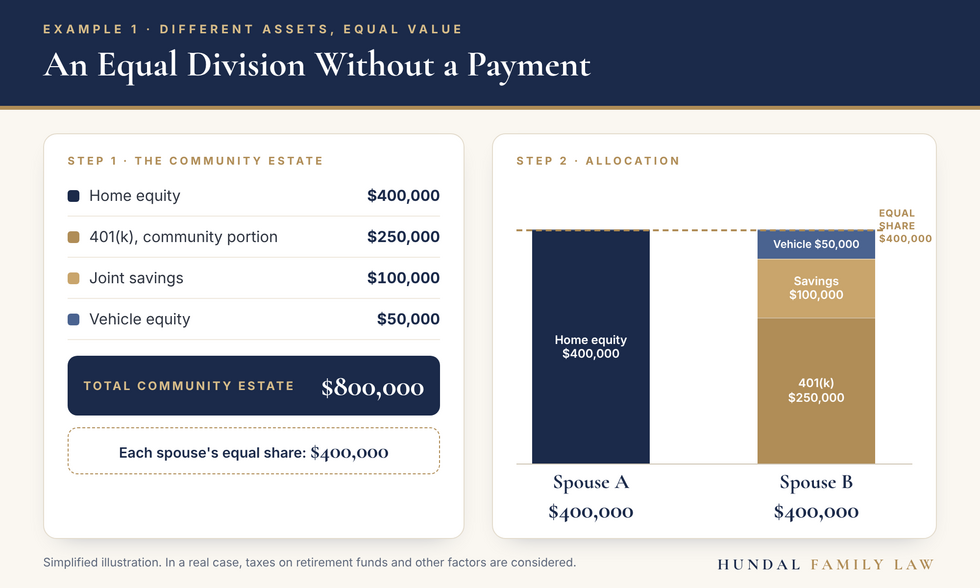
Spouse A keeps the home, worth $400,000 in equity. Spouse B keeps the 401(k), the savings, and the vehicle, which together are also worth $400,000. Neither spouse received half of any single asset, yet the division is equal, because each spouse received the same total value.
Example 2: When an Equalizing Payment Is Needed
Assets do not always divide evenly. Assume the home equity is $450,000, the community share of the 401(k) is $250,000, joint savings are $70,000, and vehicle equity is $40,000. The total community estate is $810,000, so each spouse is entitled to $405,000.
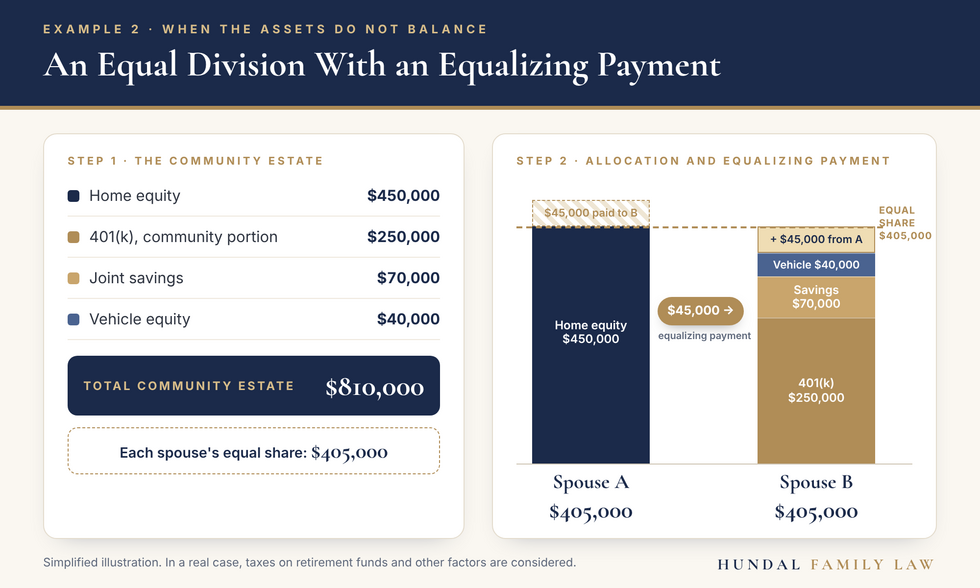
If Spouse A keeps the home, Spouse A receives $450,000, which is $45,000 more than an equal share. Spouse B receives the 401(k), savings, and vehicle, worth $360,000, which is $45,000 less. Because there is not enough other property to balance the difference, Spouse A pays Spouse B $45,000. That payment is called an equalizing payment. It is often funded through a refinance of the home or paid over an agreed schedule. After the payment, each spouse has received $405,000.
These examples are simplified. In an actual case, taxes, costs of sale, and the form of each asset are considered. For example, pretax retirement funds are not equivalent to cash.
Where the Community Ends
Why Does the Date of Separation Matter?
The date of separation marks the point at which community property stops accumulating. Under Family Code § 70, it is the date a complete and final break in the marital relationship occurred. That requires one spouse to have expressed the intent to end the marriage, and that spouse's conduct to be consistent with that intent. Earnings, savings, retirement contributions, and business income after that date are generally separate property (§ 771). For that reason, a dispute over the date of separation can materially change the outcome.
Example: Two Possible Dates of Separation
Assume one spouse saves $5,000 per month from earnings during 2025, for a total of $60,000 by year end. Savings from earnings before the date of separation are community property. Savings after that date are the earning spouse's separate property.
Scenario A: Separation on March 1
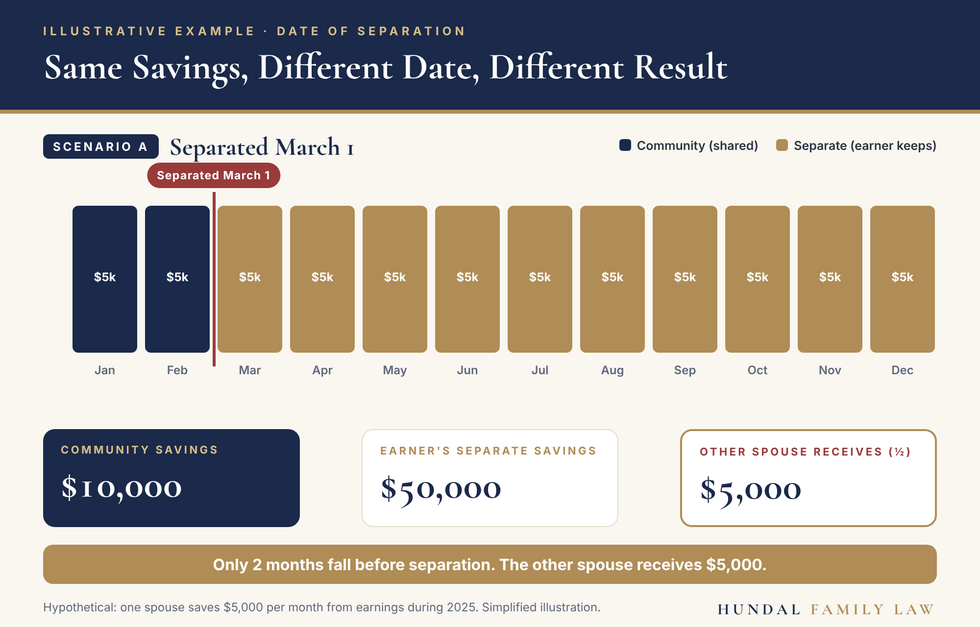
In Scenario A, only January and February fall before the date of separation. The community savings are $10,000, the earning spouse keeps $50,000 as separate property, and the other spouse receives half of the community savings: $5,000.
Now, in Scenario B, below, consider what happens when the only change is the date of separation.
Scenario B: Separation on September 1
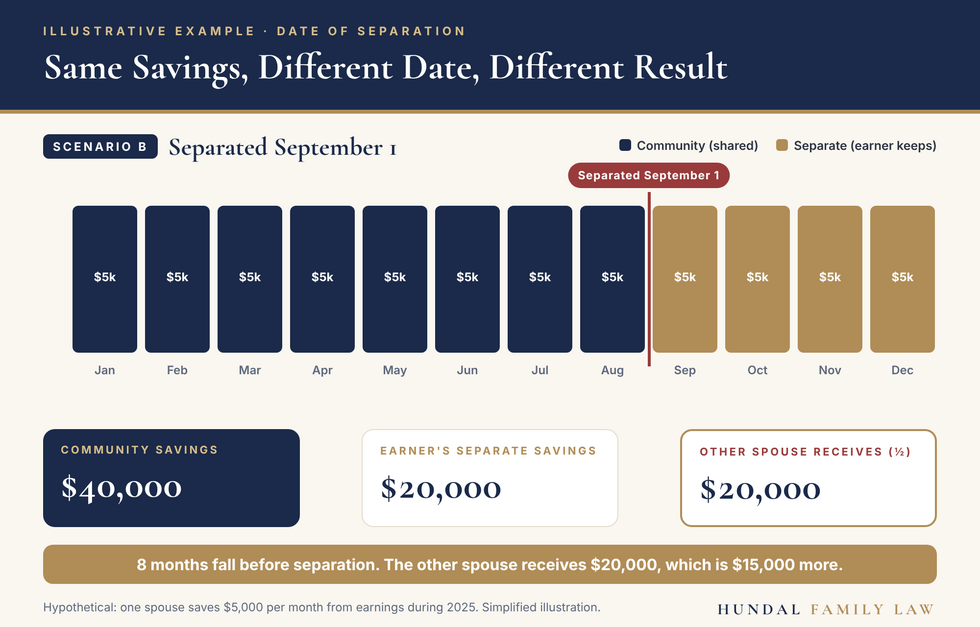
In Scenario B, January through August fall before the date of separation. The community savings are $40,000, the earning spouse keeps only $20,000 as separate property, and the other spouse receives $20,000. The savings are identical in both scenarios, but moving the date of separation by six months changes the other spouse's share by $15,000. (This example is simplified for illustration.)
The Family Home
Who Keeps the House in a California Divorce?
No rule awards the family home to either spouse. A community residence is generally handled in one of three ways:
Option 1
Sale
The home is sold, the mortgage and costs of sale are paid, and the net proceeds are divided as part of the overall division.
Option 2
Buyout
One spouse keeps the home and buys out the other spouse's share of the equity. This requires an agreed or appraised value and a plan to refinance. A divorce judgment does not release the departing spouse from the mortgage; only a refinance, sale, or lender release does.
Option 3
Deferred Sale
The spouses keep the home jointly for a defined period. The agreement should specify occupancy; responsibility for the mortgage, taxes, insurance, and repairs; any credits; and the event or date that triggers the sale.
Two further issues often affect the result. First, separate property invested in the home may give rise to a claim. A spouse who contributed separate funds toward a community home may have a reimbursement claim under § 2640. And where one spouse owned the home before marriage and community funds reduced the loan principal, the community may acquire a proportionate interest in the home, including a share of its appreciation (In re Marriage of Moore (1980) 28 Cal.3d 366; In re Marriage of Marsden (1982) 130 Cal.App.3d 426).
Second, payments and occupancy after separation matter. A spouse who pays the mortgage from post-separation earnings may seek reimbursement, known as Epstein credits. A spouse who has exclusive use of the home after separation may be charged its fair rental value, known as Watts charges.
Retirement Assets
How Are Retirement Accounts and Pensions Divided?
The portion of a 401(k), 403(b), IRA, or pension earned during the marriage is generally community property, even when only one spouse is the participant. Contributions and benefits attributable to periods before marriage or after separation are generally separate property. For defined-benefit pensions, courts commonly apply a time rule that compares years of service during the marriage to total years of service. A pension is community property to that extent even if it has not yet vested (In re Marriage of Brown (1976) 15 Cal.3d 838).
Most employer plans can be divided only by a separate court order. Private plans require a Qualified Domestic Relations Order (QDRO), and public plans such as CalPERS require a comparable domestic relations order. The divorce judgment alone does not transfer the funds. Pretax retirement assets are also not equivalent to cash: taxes, early-withdrawal penalties, plan loans, and survivor benefits all affect their real value.
Business Interests
How Is a Business Divided?
A business established during the marriage is generally community property. A business owned before the marriage is generally separate property, but the community may share in growth attributable to a spouse's efforts during the marriage. Courts allocate that growth using two established approaches. The Pereira approach applies where growth resulted primarily from the spouse's personal efforts. The Van Camp approach applies where growth resulted primarily from the business's capital and market conditions.
A business valuation considers earnings, cash flow, assets and liabilities, goodwill, owner compensation, and personal expenses paid by the business. In most cases, one spouse retains the business and the other receives an offset or equalizing payment for the community interest.
Equity Compensation
How Are Stock Options and Restricted Stock Divided?
Equity awards are often granted, vested, and exercised on different dates, so a single award may be partly community and partly separate, even before it vests. Courts apply time-based formulas to allocate the community share, such as the approach in In re Marriage of Hug (1984) 154 Cal.App.3d 780. An accurate allocation requires the award agreements, vesting schedules, and plan documents.
Community Debts
Are Debts Divided With the Property?
Yes. The community estate includes community debts as well as assets, and the court divides its net value. A judgment that assigns a joint debt to one spouse does not bind the creditor, so a spouse who remains on an account may still be pursued for payment. See our page on dividing debt in a California divorce for a full discussion.
Disclosure and Remedies
What If a Spouse Conceals Assets?
Each spouse must provide complete financial disclosures under penalty of perjury (Family Code §§ 2104, 2105), and the court may impose sanctions for failing to comply (§ 2107). Where a spouse breaches the fiduciary duty owed to the other, the court may award the other spouse 50 percent of any undisclosed or improperly transferred asset. It may award 100 percent if the breach involved oppression, fraud, or malice (§ 1101).
If a community asset is discovered after the judgment is entered, the court retains jurisdiction to divide it (§ 2556). A judgment obtained through fraud, perjury, or a failure to disclose may also be set aside, subject to strict time limits (§ 2122).
Myth vs. California Law
Common Misconceptions About Property Division
The Process
What Are the Steps in Dividing Property?
Disclosure
Each spouse serves a Preliminary Declaration of Disclosure (FL-140), a Schedule of Assets and Debts (FL-142), and an Income and Expense Declaration (FL-150) (Family Code § 2104).
Characterization
Each asset and debt is classified as community, separate, or mixed, and commingled funds are traced.
Valuation
Real estate, businesses, pensions, and other significant assets are appraised or valued.
Allocation
Assets and debts are assigned, and any equalizing payment is calculated.
Resolution
Most cases resolve through negotiation or mediation. Issues that remain in dispute are decided by the court.
Judgment
The agreement or ruling is entered as a judgment, making its terms enforceable as court orders.
Implementation
Deeds are recorded, loans are refinanced, accounts are transferred, and QDROs are prepared and served. Many divisions fail at this stage rather than at trial.
Drafting That Holds Up
What Should a Property Settlement Include?
A property settlement is only as effective as its drafting. A complete agreement should:
- ✓Identify every significant asset and debt, and state whether each is community, separate, or disputed
- ✓State agreed values, or the method for determining them
- ✓Allocate each asset and debt to a spouse
- ✓Set the amount and deadline for any equalizing payment
- ✓Address title transfers, refinance deadlines, and lender releases
- ✓Provide for the QDROs or other orders needed to divide retirement plans
- ✓Allocate taxes and costs of sale
- ✓Require proof of completion and specify remedies for noncompliance
Local Practice
Property Division in Sacramento and Surrounding Counties
In Sacramento County, family law matters are heard at the William R. Ridgeway Family Relations Courthouse, 3341 Power Inn Road. Placer, El Dorado, Yolo, and Solano Counties each maintain their own family law calendars and local rules governing settlement conferences and trial filings. In every county, property issues are decided on the documents. These include deeds, escrow files, account statements dating back to the date of marriage, and retirement plan statements.
FAQ
Frequently Asked Questions
Is California a community property state?
Yes. Property acquired by a married person during the marriage while living in California is community property unless a statute provides otherwise (Family Code § 760). In a divorce, the community estate is divided equally (§ 2550).
Who gets the house in a California divorce?
No rule awards the house to either spouse. The home may be sold, retained by one spouse through a buyout and refinance, or held jointly for a defined period. The result depends on equity, affordability, separate property claims, and the composition of the rest of the estate.
If I move out, do I lose my rights to the house?
No. Moving out does not change ownership of the home or forfeit your interest in it. It can affect who occupies the home while the case is pending. The spouse who stays may be charged for its fair rental value (Watts charges), and a spouse who pays the mortgage from post-separation earnings may claim reimbursement (Epstein credits). Because the decision to move out can have financial and practical consequences, it is worth discussing with an attorney first.
Does cheating affect how property is divided in a California divorce?
Generally, no. California is a no-fault state, and a spouse's infidelity does not change the equal division of community property. Evidence of specific acts of misconduct is generally inadmissible (Family Code § 2335). If community funds were deliberately spent on an affair, however, the court may award the other spouse an offset for the amount misappropriated (§ 2602).
Can I keep property I owned before marriage?
Generally, yes. Property owned before marriage is separate property (Family Code § 770). The spouse claiming property as separate has the burden of proving it, so keep records showing when and how you acquired it. If community funds reduced the loan principal, the community may hold a proportionate interest. If the property was placed in joint title during the marriage, it is presumed community, subject to a reimbursement claim for your separate contribution (§§ 2581, 2640).
I helped pay for a house my spouse owned before we married. Am I entitled to anything?
It depends on how the payments were made and what has happened to the loan and title since the marriage. If community funds reduced the loan principal during the marriage, and there has been no refinance, new loan, or title change, the community generally acquires a proportionate interest in the home under Moore/Marsden. In simplified terms, the community share reflects the portion of the purchase price paid down with community funds during the marriage, applied to the home's appreciation during the marriage, plus the principal reduction itself. Payments of interest, taxes, and insurance do not count, and neither do payments made before the marriage. If you used your own separate funds toward the property, you may have a separate claim for reimbursement (§ 2640). A refinance, new loan, or change in title can change the analysis significantly. Reconstructing these figures requires loan histories, payment records, and often an appraisal, which is why these claims should be evaluated by an attorney.
Is an inheritance divided in a California divorce?
No. An inheritance received by one spouse is that spouse's separate property (Family Code § 770). The spouse claiming the inheritance as separate property has the burden of proving it. If it was deposited into a joint account or used to purchase a shared asset, that spouse must trace it with records such as estate documents, deposit records, and account statements.
Is my spouse entitled to part of my retirement?
To the extent it was earned during the marriage, generally yes. Contributions made before marriage or after the date of separation are generally separate property. Most plans require a QDRO or comparable order to divide the benefits.
What happens to a business in a divorce?
A business may be community, separate, or both. It is typically valued, then retained by one spouse, with the other spouse receiving an offset or equalizing payment for the community interest.
Who gets the family pet in a California divorce?
California law allows the court to assign sole or joint ownership of a pet, taking into account the care of the animal (Family Code § 2605). The court may also make temporary orders for the pet's care while the case is pending. Pets are no longer treated simply like furniture or other personal property.
What if my spouse is hiding assets?
Both spouses must make complete disclosures under penalty of perjury (Family Code §§ 2104, 2105). If a spouse breaches the fiduciary duty, the court may award the other spouse 50 percent of the concealed asset, or 100 percent where fraud, oppression, or malice is shown (§ 1101).
Can a property division be changed after the divorce is final?
A property division is generally final. However, community property that the judgment did not divide may be divided later (Family Code § 2556), and a judgment obtained through fraud, perjury, or a failure to disclose may be set aside within strict time limits (§ 2122).
Hundal Family Law · Sacramento, California
Schedule a Consultation
If you are dividing a home, retirement benefits, a business, or separate property in a divorce in Sacramento or the surrounding counties, schedule a consultation with Hundal Family Law. We represent clients in Sacramento, Placer, El Dorado, Yolo, and Solano Counties.
Call (916) 864-3944This article provides general information, not legal advice. Reading it does not create an attorney-client relationship.
Last updated: November 2026