
If you or a child are in immediate danger, call 911.
The Short Answer
A domestic violence restraining order (DVRO) is a family court order that protects a person from abuse by a current or former spouse, dating partner, cohabitant, co-parent, or close relative. California law expressly provides that abuse is not limited to physical injury; it includes threats, stalking, harassment, coercive control, and conduct that destroys a person's mental or emotional calm. A judge may issue temporary orders before a hearing, and an order after hearing may last up to five years and be renewed (Family Code §§ 6203, 6211, 6320, 6345).
Jaspreet Hundal is a Sacramento domestic violence attorney who represents clients in Sacramento, Roseville, and throughout Sacramento, Placer, Yolo, and Solano Counties, both those seeking protection and those responding to allegations of abuse. As a restraining order attorney, Jaspreet Hundal handles requests, responses, hearings, trials, renewals, and the custody issues that often come with them.
The Basics
What Is a Domestic Violence Restraining Order?
A DVRO is a civil court order issued under California's Domestic Violence Prevention Act (Family Code § 6200 et seq.) to prevent abuse. Depending on the evidence and the relief requested, it may prohibit abusive conduct and contact, require a person to stay away from the protected person and specified places, exclude a person from a shared home, prohibit firearm possession, and address child custody, visitation, and support. A DVRO is not a criminal charge, but violating one is a crime (Penal Code § 273.6).
Qualifying Relationships
Who Can Request a Domestic Violence Restraining Order?
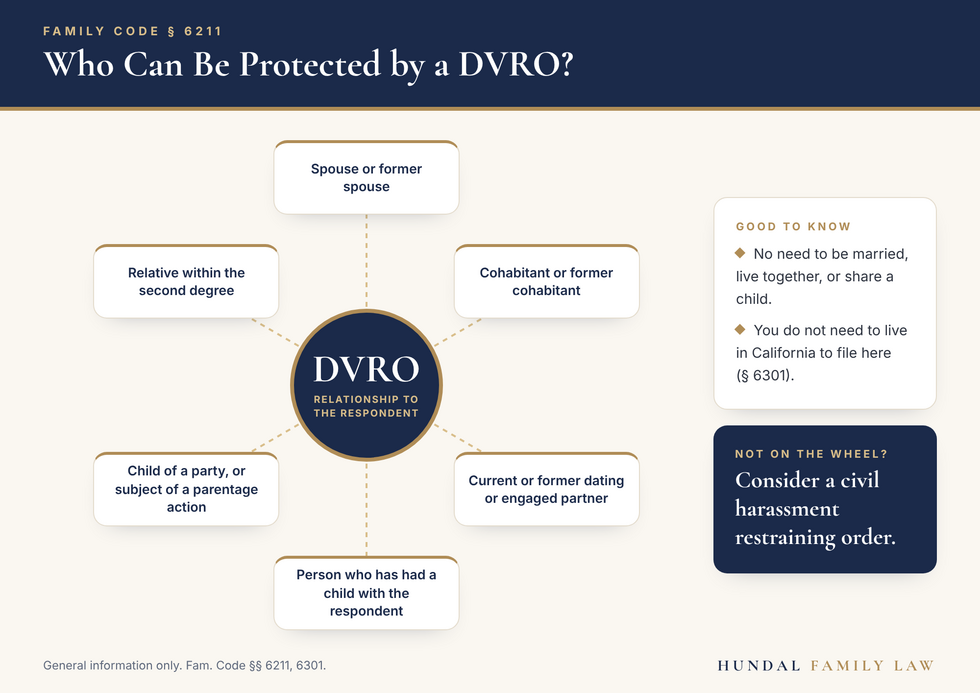
A DVRO requires a qualifying relationship. Family Code § 6211 provides:
“Domestic violence” is abuse perpetrated against any of the following persons:
- aA spouse or former spouse.
- bA cohabitant or former cohabitant, as defined in Section 6209.
- cA person with whom the respondent is having or has had a dating or engagement relationship.
- dA person with whom the respondent has had a child, where the presumption applies that the male parent is the father of the child of the female parent under the Uniform Parentage Act (Part 3 (commencing with Section 7600) of Division 12).
- eA child of a party or a child who is the subject of an action under the Uniform Parentage Act, where the presumption applies that the male parent is the father of the child to be protected.
- fAny other person related by consanguinity or affinity within the second degree.
California Family Code § 6211
The “respondent” is the person the order would be against. “Consanguinity” means related by blood, and “affinity” means related by marriage. “Within the second degree” covers close family such as parents, children, siblings, grandparents, grandchildren, and in-laws.
The parties do not need to be married, live together, or share a child; a current or former dating relationship can qualify. A person without a qualifying relationship may instead seek a civil harassment restraining order. A person does not need to live in California to request a DVRO here (§ 6301).
Defining Abuse
What Counts as Abuse Under California Law?
The Short Answer
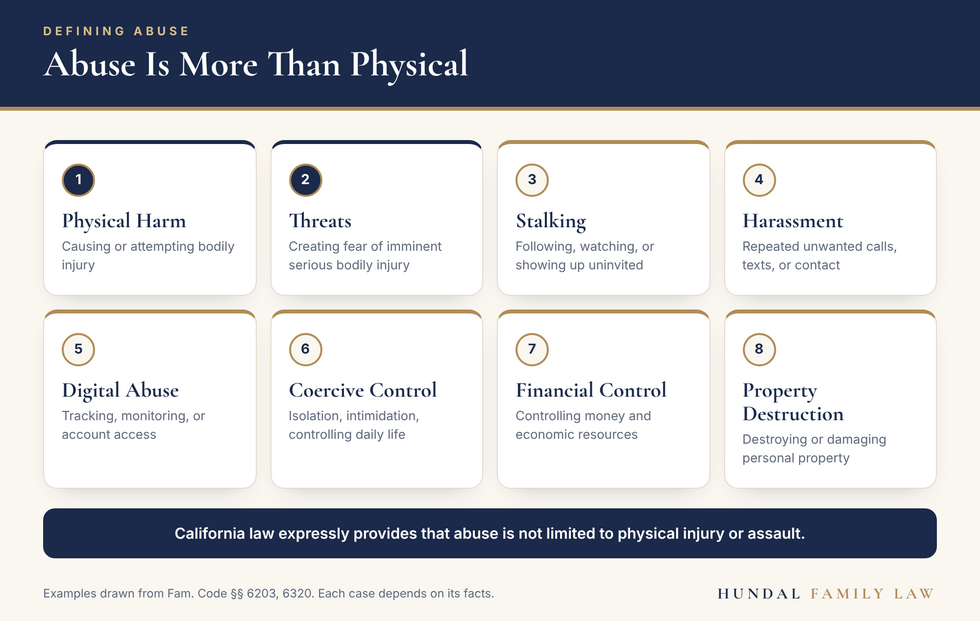
Abuse is broader than physical violence. California law expressly provides that abuse “is not limited to the actual infliction of physical injury or assault” (Family Code § 6203(b)).
Under Family Code § 6203(a), abuse means any of the following:
- 1To intentionally or recklessly cause or attempt to cause bodily injury.
- 2Sexual assault.
- 3To place a person in reasonable apprehension of imminent serious bodily injury to that person or to another.
- 4To engage in any behavior that has been or could be enjoined pursuant to Section 6320.
California Family Code § 6203
To “enjoin” means to order someone to stop doing something. So the fourth category means that any conduct a court is allowed to order a person to stop, under Section 6320, also counts as abuse.
What Conduct Does Section 6320 Cover?
The fourth category refers to Family Code § 6320. Conduct the statute allows a court to enjoin, and that therefore counts as abuse, includes:
Physical and sexual harm
MolestingAttackingStrikingBatteringSexually assaultingThreats and stalking
ThreateningStalkingHarassment
HarassingTelephoning, including annoying callsRepeated unwanted contactImpersonation
Credibly impersonating (Penal Code § 528.5)Falsely personating (Penal Code § 529)Property
Destroying personal propertyDisturbing the peace
Repetitive name-calling or degrading messagesCoercive controlOther conduct that destroys mental or emotional calmSection 6320 also authorizes the protections a court can order, such as no-contact and stay-away orders. Those are remedies, not forms of abuse, and are covered below under what a restraining order can include.
Disturbing the Peace
“Disturbing the peace” means conduct that, based on the totality of the circumstances, destroys the other person's mental or emotional calm (§ 6320(c)). “Totality of the circumstances” means the judge looks at the whole picture, not one moment in isolation. It can be committed:
- Directly or indirectly, including through a third party
- By any method, including telephone, text messages, online accounts, internet-connected devices, or other electronic technologies
California courts have recognized that the Act is not limited to physical harm, threats of physical harm, or severe emotional distress (In re Marriage of Ankola (2020) 53 Cal.App.5th 369).
That does not mean every argument, unpleasant exchange, or unwanted message is domestic violence. The court evaluates the evidence and the overall circumstances. But the absence of physical injury does not, by itself, prevent a finding of abuse.
Coercive Control
Coercive control is a pattern of behavior that, in purpose or effect, unreasonably interferes with a person's free will and personal liberty (§ 6320). Examples identified in the statute include unreasonably:
- Isolating a person from friends, relatives, or other sources of support
- Depriving a person of basic necessities
- Controlling, regulating, or monitoring the person's movements, communications, daily behavior, finances, economic resources, or access to services
- Using force, threats, or intimidation, including threats based on actual or suspected immigration status, to compel conduct the person has a right to refrain from, or to prevent conduct the person has a right to engage in
Coercive control claims are highly fact-specific. Courts consider the pattern of conduct, its purpose or effect, and the evidence presented by both parties.
Step by Step
How Does a Domestic Violence Restraining Order Case Work?
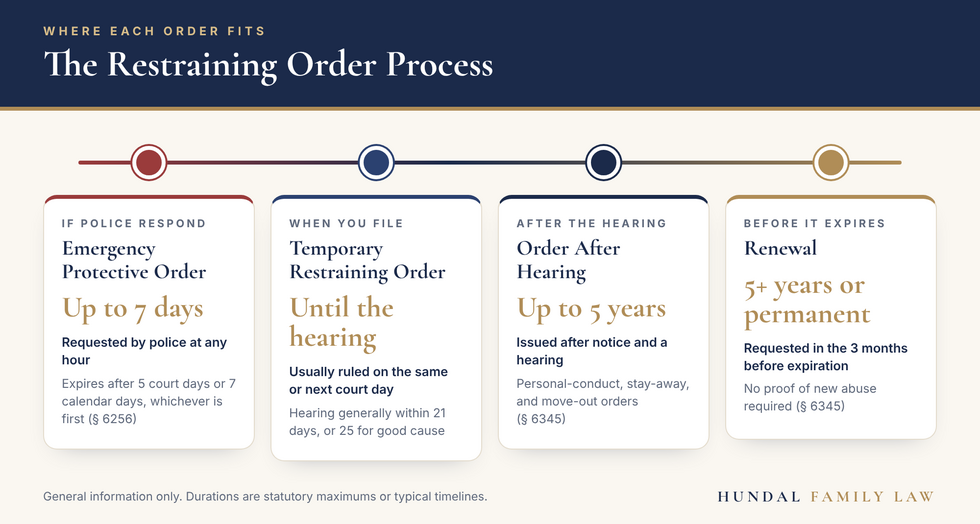
A DVRO case moves through a set sequence. Each type of order comes into play at a specific point: a temporary order when you file, an order after hearing if the judge grants your request, and a renewal before that order expires.
File your request with the family court
Complete the Request for Domestic Violence Restraining Order (DV-100), which includes a declaration, a written statement signed under penalty of perjury, describing the abuse. A parent requesting custody orders also completes form DV-105. There is no filing fee, and a request on the required forms that identifies both parties may not be denied for technical reasons (§ 6300).
The judge decides whether to issue a temporary restraining order (TRO)
Based only on your written request, the judge decides whether to grant some, all, or none of the temporary orders, generally on the day you file or the next court day (§ 6326). The judge also sets a hearing date, generally within 21 days, or 25 days for good cause. The TRO lasts until the hearing.
Serve the other party
Someone 18 or older who is not a party must personally serve the restrained person with the request, the TRO, and the hearing notice. Law enforcement will serve them at no cost. The other party must follow the TRO once served.
Attend the hearing
Both parties may present evidence and testimony, and the judge decides whether past abuse has been shown by a preponderance of the evidence. If the judge denies the request, the TRO ends.
Restraining order after hearing
If the judge grants the request, the court issues a restraining order after hearing. Personal-conduct, stay-away, and residence-exclusion orders may last up to five years (§ 6345). This order is often called a “permanent” restraining order, but it has an end date unless it is later renewed permanently.
Renewal before it expires
During the three months before the order expires, the protected person may ask to renew it. The court may renew the order for five or more years, or permanently, without proof of further abuse, if the protected person has a reasonable apprehension of future abuse (§ 6345; Ritchie v. Konrad (2004) 115 Cal.App.4th 1275).
What if the case needs more time?
Contested cases are often set for trial.
The first hearing date is usually short. If a case cannot generally be heard in about 15 to 30 minutes, or it involves multiple witnesses, it is most likely to be set for a longer evidentiary hearing or trial on a later date. The court can keep the temporary restraining order in effect until then. Both sides should be prepared for that possibility at the first hearing.
Where does an emergency protective order fit?
An emergency protective order (EPO) comes before the family court case, not during it.
When police respond to an incident, the officer can request an EPO from an on-call judicial officer at any hour. It lasts up to five court days or seven calendar days, whichever comes first (§ 6256). That gives the protected person time to file a request with the family court, which is Step 1 above.
The Scope of an Order
What Can a Domestic Violence Restraining Order Include?
The terms depend on the evidence and the relief requested.
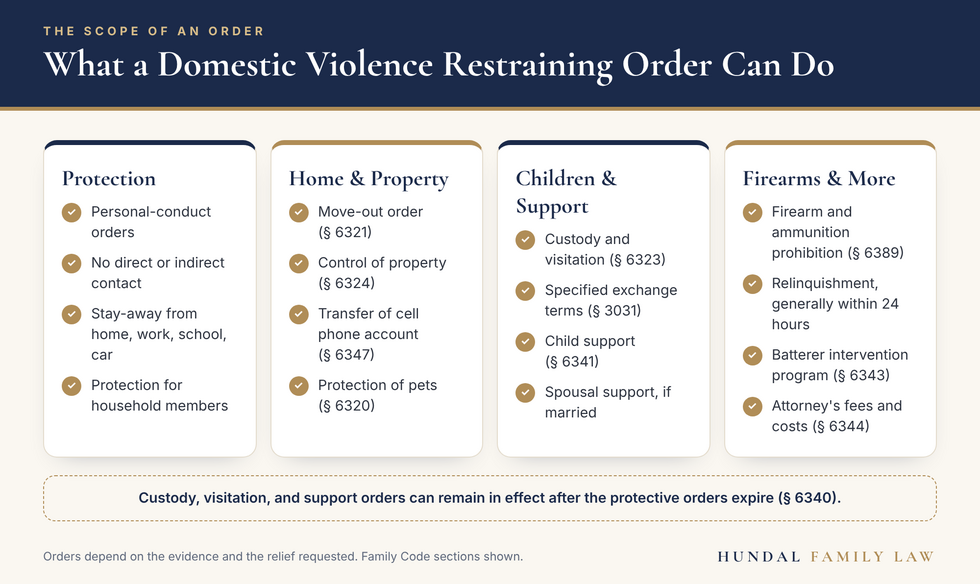
- Personal-conduct orders prohibiting harassing, threatening, attacking, stalking, or disturbing the peace of the protected person.
- No-contact orders prohibiting direct or indirect contact, including by phone, text, mail, email, or online accounts.
- Stay-away orders requiring the restrained person to remain a specified distance from the protected person and designated places, such as a home, workplace, school, or vehicle. The signed order's precise terms control.
- Residence exclusion (move-out) orders excluding a party from a shared home, regardless of which party owns or leases it, when the statutory requirements are met (§ 6321). A move-out order determines who may occupy the home while it is in effect; it does not decide ownership.
- Child custody and visitation orders (§ 6323). When a protective order has been issued, the custody or visitation order must specify the time, day, place, and manner of child exchanges to limit contact between the parents (§ 3031).
- Firearm restrictions. The restrained person may not own, possess, purchase, or receive firearms or ammunition while the order is in effect. Firearms must be relinquished to law enforcement or sold to or stored with a licensed firearms dealer, generally within 24 hours of service, with proof filed with the court (§ 6389).
- Other orders, including child support and, for married parties, spousal support (§ 6341); control of property (§ 6324); protection of pets (§ 6320); transfer of a cell phone account (§ 6347); completion of a batterer intervention program (§ 6343); and attorney's fees and costs (§ 6344).
On a showing of good cause, the order may also protect other named family or household members. Custody, visitation, and support orders made in a DVRO case can remain in effect after the protective orders expire (§ 6340).
The Hearing
What Is the Standard of Proof at a DVRO Hearing?
The “standard of proof” is how convincing the evidence has to be before the judge can rule in someone's favor. In a restraining order case, the standard is a “preponderance of the evidence.”
A preponderance of the evidence means “more likely than not.” Picture a scale: the person asking for the order must tip it, even slightly, in their favor. That is a lower bar than “beyond a reasonable doubt,” the standard used in criminal cases, which requires near certainty.
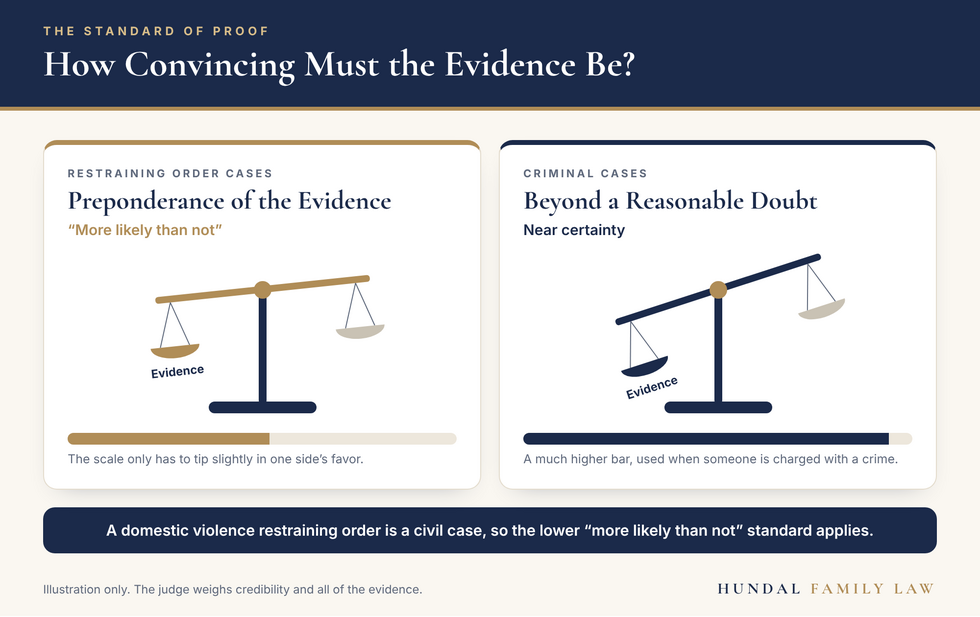
The person requesting the order must show past abuse by a preponderance of the evidence, and the court considers the totality of the circumstances. The court may issue an order based on the requesting party's own declaration or testimony if it provides reasonable proof of a past act or acts of abuse (§ 6300). A police report, medical record, or physical injury is not required. The judge determines credibility, weighs the evidence, and grants, denies, or modifies the requested orders.
Building the Record
What Evidence Matters in a Domestic Violence Case?
Domestic violence cases often turn on the details and credibility of the evidence. Depending on the allegations, relevant evidence may include:
- ✓Text messages, emails, call logs, and social media or other online communications
- ✓Photographs of injuries or damaged property
- ✓Medical and law enforcement records
- ✓Financial records relevant to alleged economic control
- ✓Records showing repeated contact, tracking, monitoring, or impersonation
- ✓Testimony from witnesses with personal knowledge
- ✓A clear chronology of what happened, when, where, who was present, and what followed
Preserve evidence in its original form. Do not crop, annotate, or selectively delete messages in a way that changes their context, and access devices, accounts, and records only by lawful means.
In a declaration, specific descriptions are more persuasive than labels. Describing the exact words used, the conduct observed, and its effect gives the court far more than saying someone was “abusive” or “controlling.” Distinguish what you personally observed from what you believe or assume.
For Protected Parties
If You Are Seeking Protection
If it is safe to do so:
Address immediate safety
Call 911 if you or a child is in danger.
Preserve evidence
Save communications, photographs, and records without altering them.
Prepare a chronology
List specific events, approximate dates, locations, witnesses, statements, threats, injuries, and patterns.
Identify the protection you need
Note the people, homes, workplaces, schools, and other places the orders should cover.
Describe nonphysical abuse precisely
For stalking, monitoring, isolation, financial control, or threats, explain the pattern and its effect on you.
Address the children
Explain your safety concerns and the custody, visitation, and exchange terms you are requesting.
Disclose existing orders
Provide any existing custody or restraining orders, and follow them.
For Responding Parties
If You Have Been Served With a Restraining Order Request
Being served with temporary orders does not mean the court has made a final decision. It does mean the temporary orders must be followed until the court changes them.
Read every page
Note the hearing date, the courtroom, and every restriction in the order.
Follow all orders, including:
The temporary orders are enforceable as soon as you are served, even if you believe the allegations are untrue.
- No-contact orders, including indirect contact through relatives, friends, the children, or online accounts. Contact can lead to arrest even if the protected person reaches out first.
- Stay-away orders from the protected person and the places listed in the order.
- Move-out orders, if the order requires you to leave a shared home.
- Custody and visitation orders, if any were made.
- Firearm orders. Relinquish (give up) all firearms and ammunition to law enforcement, or sell them to or store them with a licensed dealer, generally within 24 hours, and file proof with the court (§ 6389).
You must show up for your court date
This is the most important step. If you do not appear, the hearing can go forward without you, and the judge can grant the restraining order, for up to five years, without hearing your side.
Preserve your evidence
Do not delete messages, change accounts, or post about the case online.
Know your right to one continuance
A continuance means postponing the hearing to a later date. The restrained party is entitled, as a matter of course, to one continuance for a reasonable period to respond to the request (Family Code § 245). Either party may also ask for a continuance for good cause. If the hearing is continued, the temporary restraining order generally remains in effect until the continued hearing.
Decide whether to file a response
The usual response form is the Response to Request for Domestic Violence Restraining Order (DV-120), which should address each allegation specifically and identify witnesses with personal knowledge.
- If criminal charges are pending or possible, anything you say in a written response or in testimony can be used against you in the criminal case. In that situation, you may decide not to file a response or testify, to protect your Fifth Amendment right against self-incrimination. Speak with an attorney before filing anything.
Check for conflicts
Determine whether the requested orders conflict with existing custody, support, or property orders.
A restraining order after hearing can affect custody, housing, firearm rights, employment, and professional licensing, so prompt preparation matters.
Custody and Parenting Time
How Does Domestic Violence Affect Child Custody?
If the court finds that a parent seeking custody committed domestic violence within the previous five years against the other parent, the child, the child's sibling, or another person covered by the statute, a rebuttable presumption arises that awarding that parent sole or joint legal or physical custody is detrimental to the child's best interest (§ 3044). The parent may rebut the presumption by a preponderance of the evidence under factors the statute lists, which, as of 2026, may include violations of firearm restrictions.
A “rebuttable presumption” means the court starts from an assumption, here that custody with the parent who committed domestic violence is not good for the child, but that parent can try to prove otherwise with evidence.
A domestic violence finding does not resolve every parenting issue. The court must still make orders that protect the child's health, safety, and welfare (§ 3011), including orders on supervised or suspended visitation, neutral or protected exchange locations, third-party help with exchanges, and communication about the children. Learn more on our child custody page.
Enforcement
What Happens If a Restraining Order Is Violated?
A restraining order is a court order, and violating it is serious. The restrained person can be arrested, and the district attorney can file criminal charges for the violation (Penal Code § 273.6). A conviction can result in jail time, fines, or both, and penalties increase for repeat violations or violations that cause injury. Possessing a firearm while prohibited by a protective order is a separate crime (Penal Code § 29825).
A protected person cannot give the restrained person permission to disregard the order. Only the court can modify or terminate it.
Modification
Can a Domestic Violence Restraining Order Be Changed or Ended?
Yes. Either party may ask the court to modify or terminate the order (§ 6345). Until the court changes it, every term remains enforceable.
Two Different Courts
How Is a DVRO Different From a Criminal Protective Order?
A criminal protective order is issued by a judge in a criminal case, usually after an arrest, and the prosecutor controls that case. A DVRO is requested by the protected person in family court, whether or not criminal charges are filed. Both can exist at the same time.
Working With an Attorney
How Can a Domestic Violence Attorney Help?
You are not required to have a lawyer to request or respond to a restraining order. But the hearing is often the only chance to present your evidence, and the outcome can affect your safety, your home, your children, and your rights for years. A domestic violence attorney can help on either side of the case.
If you are seeking protection
Preparing a clear, specific declarationRequesting the right orders, including custody and move-out ordersOrganizing evidence and witnessesPresenting your case at the hearing or trialRenewing the order before it expiresIf you have been served
Explaining what the temporary orders requireEvaluating Fifth Amendment concerns if criminal charges are possibleRequesting a continuance when appropriateResponding to each allegation with evidenceCross-examining witnesses at the hearing or trialLocal Practice
Domestic Violence Restraining Orders in Sacramento, Roseville, and Surrounding Counties
In Sacramento County, family law matters are heard at the William R. Ridgeway Family Relations Courthouse, 3341 Power Inn Road. Placer County, which includes Roseville, Rocklin, and Lincoln, along with Yolo and Solano Counties, each have their own family law self-help centers and filing procedures.
Myth vs. California Law
Common Misconceptions About Domestic Violence Restraining Orders
FAQ
Frequently Asked Questions
What is the burden of proof at a California DVRO hearing?
The requesting party must show past abuse by a preponderance of the evidence. The court considers the totality of the circumstances (Family Code § 6300).
Who can get a domestic violence restraining order?
A person abused by a current or former spouse, cohabitant, dating partner, co-parent, or a relative within the second degree (§ 6211). Others may seek a civil harassment restraining order.
Do I need police reports or medical records?
No. The court may rely on testimony and declarations, and physical injury is not required. Records, photographs, messages, and witnesses can provide corroboration.
Can text messages or online conduct support a DVRO?
Yes. Conduct that disturbs a person's peace may be committed through text messages, online accounts, internet-connected devices, third parties, or other electronic means (§ 6320).
Can financial control be abuse?
Yes. Coercive control includes unreasonably controlling, regulating, or monitoring a person's finances, economic resources, communications, movements, or access to services (§ 6320).
How quickly can I get a temporary restraining order?
A judge generally rules on a temporary order the day it is filed or the next court day (§ 6326). The hearing on a longer order is generally held within 21 to 25 days.
How long does a DVRO last?
After a hearing, personal-conduct, stay-away, and residence-exclusion orders may last up to five years, and may be renewed for five or more years, or permanently (§ 6345).
Do I need a domestic violence attorney for a restraining order hearing?
No, a lawyer is not required. But a restraining order after hearing can last up to five years and affect custody, housing, and firearm rights, so many people choose to work with a domestic violence attorney, especially when the case is contested, involves children, or may be set for trial.
Will my restraining order case be decided at the first hearing?
Not always. If the case cannot generally be heard in about 15 to 30 minutes, or it involves multiple witnesses, it is most likely to be set for a longer evidentiary hearing or trial on a later date. The court can keep the temporary restraining order in effect until then.
Do I have to prove new abuse to renew a DVRO?
No. Renewal does not require proof of further abuse after the original order. The court determines whether renewal is appropriate (§ 6345).
Does it cost money to file?
No. There is no filing fee for a domestic violence restraining order, and law enforcement will serve it at no cost.
Can the court order someone to move out?
Yes. The court may exclude a party from a shared home regardless of who owns or leases it, when the statutory requirements are met (§ 6321).
Can the order protect my children or other household members?
Yes. The court may protect qualifying children and, on a showing of good cause, other named family or household members.
What happens to custody when domestic violence is found?
A finding within the previous five years creates a rebuttable presumption against awarding the person who committed it sole or joint custody (§ 3044). The court may also order supervised visitation or protected exchanges.
Can custody or support orders continue after the restraining order expires?
Yes. Custody, visitation, and support orders made in the proceeding may survive the expiration of the protective orders (§ 6340).
Does a DVRO prohibit firearm possession?
Yes. The restrained person may not own, possess, purchase, or receive firearms or ammunition and must relinquish them as the order directs (§ 6389).
What happens if I don't show up to the restraining order hearing?
The hearing can go forward without you, and the judge can grant the restraining order, for up to five years, without hearing your side. Showing up is the single most important thing a restrained party can do.
Can I get more time to respond to a restraining order request?
Yes. The restrained party is entitled, as a matter of course, to one continuance for a reasonable period to respond (Family Code § 245). The temporary restraining order generally remains in effect until the continued hearing.
What should I do if I disagree with the allegations?
Follow all temporary orders, preserve complete evidence, and appear at the hearing. Do not contact the protected person to explain your side. If criminal charges are pending or possible, speak with an attorney before filing a response, because what you say can be used in the criminal case.
What is the difference between a DVRO and a criminal protective order?
A DVRO is requested by the protected person in family court. A criminal protective order is issued in a criminal case. Both can exist at once.
Should I include every argument or disagreement in my request?
No. Focus on conduct that meets the legal definition of abuse and supports the specific orders you are requesting. Clear, chronological, fact-based descriptions are the most effective.
Hundal Family Law · Sacramento, California
Speak With a Sacramento Domestic Violence Attorney
Domestic violence proceedings can affect safety, housing, parenting time, and firearm rights. Whether you are seeking protection or responding to allegations in Sacramento, Roseville, or anywhere in Placer, Yolo, or Solano County, schedule a consultation with domestic violence attorney Jaspreet Hundal at Hundal Family Law.
Call (916) 864-3944This article provides general information, not legal advice. Reading it does not create an attorney-client relationship.